Small Project Development Case: Inception
| Table of Contents - Introduction - General Tailoring - Project Lifecycle - Inception - Elaboration - Construction - Transition - Artifacts | Topics (on this page) - Gantt Chart - Task Descriptions |
Gantt Chart
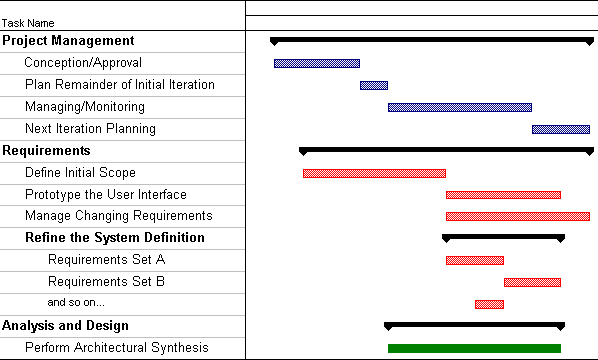
This illustration shows how the first iteration of a small project might be planned. The lengths of the bars in the chart (indicating duration) have no absolute significance. There is also no intention to suggest the application of a uniform level of effort across the duration of the workflows. You can navigate to the corresponding task description from each line of the chart - just click on the task name.
Task Descriptions
| Task | Description |
| Project Management: | |
| Conception/Approval | This includes the workflow details: - Conceive New Project - Evaluate Project Scope and Risk - Develop Software Development Plan The main output artifacts are: - an approved Business Case, - preliminary Vision - Software Development Plan (including Risk List). A more detailed plan would include some review milestones. |
| Plan Remainder of Initial Iteration | This includes workflow details: - Plan for Next Iteration. The principal output artifact is: - Iteration Plan. |
| Managing/Monitoring | This represents ongoing project management activities, including the following workflow details: - Manage the Iteration - Monitor and Control Project The principal output artifacts are: - Review Records - Iteration Assessment - Status Assessment |
| Next Iteration Planning | This includes workflow details: - Plan for Next Iteration - Develop Software Development Plan (optional, depending on scope of change) - Define Evaluation Mission (Test Manager related activities) The principal output artifacts are: - Iteration Plan - updated based on what new functionality is to be added during the new iteration, factoring in the current level of product maturity, lessons learned from the previous iterations, and any risks that need to be mitigated in the upcoming iteration) - Software Development Plan - all subplans updated as required to reflect changes in scope and risk. The Risk List in particular must be revisited if there are significant remaining risks - Test Plan - updated to reflect the mission for the next iteration’s testing. The results of status assessments and iteration assessments should be considered in determining if any changes to process and tools are necessary. |
| Requirements | |
| Define Initial Scope | This includes the workflow details: - Analyze Problem - Understand Stakeholder Needs - Define the System - Manage the Scope of the System - Manage Changing Requirements. The main output artifact is a complete Vision, including the most important use cases prioritized by the Software Architect. (The Vision will be further refined as more Use Cases are detailed). |
| Prototype the User Interface | This includes the Activity: Prototype the User Interface. The main output artifact is User-Interface Prototype. |
| Manage Changing Requirements | This tasks tracks effort related to managing changes to requirements described in the initial Vision (as baselined at the end of the task Define Initial Scope). The relevant workflow detail is: Manage Changing Requirements. |
| Refine the System Definition - Requirements Set A - Requirements Set B - and so on | This includes the workflow detail Refine the System Definition (except for user-interface related activities, which are a separate task). The main output artifacts are: - a Use Case Model (with highest priority use cases detailed) - updated Vision and Supplementary Specifications. The effort to define requirements is divided into smaller tasks with shorter durations (around 1 week is typical). These are represented in the example plan as “Requirements Set A”, “Requirements Set B”, and so on. Tasks are typically organized around use cases or scenarios, with other tasks to detail supplemental requirements or investigate specific issues or risks. |
| Analysis and Design | |
| Perform Architectural Synthesis | If the risks are judged to be high, then it may be necessary to do more exploration in this initial inception phase iteration. This workflow detail is: - Perform Architectural Synthesis The main output artifact is an Architectural Proof-of-Concept. |
Configuration Management tasks (workflow details: Change and Deliver Configuration Items and Manage Change Requests) are folded into the above tasks. Administrative and environment support tasks have been omitted for simplification.
Result
The scope of the project should be understood, and the stakeholders initiating the project should have a good understanding of the project’s ROI (return on investment), i.e. what is returned, for what investment cost. Given this knowledge, a go/no go decision can be taken.
Subsequent Iterations In Inception
In cases where the project involves new product roll-out or creation of new technology, subsequent iterations may be needed to further define the scope of the project, the risks and the benefits. This may involve further enhancing the use-case model, business case, risk list, architectural proof-of-concept, or project and iteration plans. Extension of the Inception phase may also be advisable in cases where both the risk and the investment required are high, or where the problem domain is new or the team inexperienced.