Small Project Development Case: Construction
| Table of Contents - Introduction - General Tailoring - Project Lifecycle - Inception - Elaboration - Construction - Transition - Artifacts | Topics (on this page) - Gantt Chart - Task Descriptions |
Gantt Chart
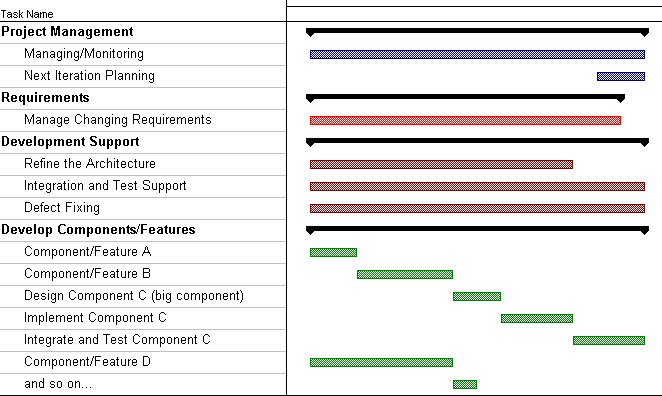
This illustration shows how construction phase for a small project could be organized. The lengths of the bars in the chart (indicating duration) have no absolute significance. You can navigate to the corresponding task description from each line of the chart by clicking on the task name.
Task Descriptions
| Task | Description |
| Project Management: | |
| Managing/Monitoring | This represents ongoing project management activities, including the following workflow details: - Manage the Iteration - Monitor and Control Project On this small project, the Project Manager is also the Test Manager, so this task also includes: - Achieve Acceptable Mission (activities: Assess and Advocate Quality, Assess and Improve Test Effort) The principal output artifacts are: - Review Records - Iteration Assessment - Status Assessment |
| Next Iteration Planning | This includes workflow details: - Plan for Next Iteration - Develop Software Development Plan (optional, depending on scope of change) - Define Evaluation Mission (Test Manager related activities) The principal output artifacts are: - Iteration Plan - updated based on what new functionality is to be added during the new iteration, factoring in the current level of product maturity, lessons learned from the previous iterations, and any risks that need to be mitigated in the upcoming iteration) - Software Development Plan - all subplans updated as required to reflect changes in scope and risk. The Risk List in particular must be revisited if there are significant remaining risks - Test Plan - updated to reflect the mission for the next iteration’s testing. The results of status assessments and iteration assessments should be considered in determining if any changes to process and tools are necessary. |
| Requirements | |
| Manage Changing Requirements | Requirements discovery and refinement is shown as complete at this stage, the remaining effort relating entirely to the management of change. The relevant workflow detail is: Manage Changing Requirements. |
| Development Support | |
| Refine the Architecture | The Software Architect has an ongoing task, which lessens as the project matures, to make any necessary changes to the software architecture. The relevant workflow detail is Refine the Architecture. |
| Integration and Test Support | Maintaining the build environment, selecting and running regression tests on builds, is an ongoing task. The relevant workflow details are: - Validate Build Stability - Manage Baselines and Releases |
| Defect Fixing | Fixing defects in previously developed code is an ongoing task. The relevant workflow details are the same as for the “Develop Components/Features” tasks. |
| Develop Components/Features - Component/Feature A - Component/Feature B - and so on | Many tasks are organized around a feature, use case, or scenario being implemented. Thus one task will often include the following workflow details: - Design Components (or Design the Database) - Implement Component - Integrate the System - Test and Evaluate - Improve Test Assets Other tasks may design and implement components that then support multiple features, use cases, or scenarios. Large tasks (more than a couple of weeks) may be divided into subtasks of incremental functionality. Other large tasks may be subdivided by the principal activity being performed. For example, into: - Design - may include some prototyping - Implement - includes (in this small project) all unit testing - Integrate and Test - including fixing bugs found in the new code during integration. (Bugs in existing code are covered by the Defect Fixing task). |
Configuration Management tasks (workflow details: Change and Deliver Configuration Items and Manage Change Requests) are folded into the above tasks. Administrative and environment support tasks have been omitted for simplification.